Some people only notice their chin when they see a photo taken from the side. The nose suddenly looks larger, the jawline seems to fade into the neck and the face appears less defined than it does in the mirror. Very often, the reason is not the nose or the neck at all, but a chin that sits too far back. This is exactly the situation in which weak chin surgery can make a meaningful difference, bringing back balance to the profile with a change that looks natural rather than artificial.
At the clinic of Dr. Babak Hatami in Dubai, patients who come to ask about a Chin Tuck in Dubai often discover that what they really want is not a different face, but a more harmonious profile. In this article we will answer the most common questions that begin with “what”: what a weak chin is, what weak chin surgery involves, what options exist, what recovery looks like, what results are realistic and what influences the overall investment.
What Is a Weak Chin and How Does It Affect Your Facial Profile?
A weak chin, also called a receding or retruded chin, is a chin that does not project forward enough in relation to the rest of the face. Looking at someone from the side, the chin seems to slope backwards towards the neck instead of creating a clear, defined point at the bottom of the face. The result is a profile that can look unbalanced, even when every other feature is attractive.
To understand why the chin matters so much, imagine the face as a picture frame. The forehead sits at the top, the nose in the middle and the chin at the base. If the base of the frame is too short, the whole picture looks tilted. A small chin makes the nose look larger, the lips look more prominent and the jawline appear softer than it really is.
A weak chin can have different origins:
- genetics, as the shape and size of the jaw bones are largely inherited
- the natural development of the jaw during growth
- the way the upper and lower teeth meet, known as the bite
- ageing, as bone and soft tissues gradually lose volume over the years
Not every weak chin is the same. In some people the bone is well positioned but simply short. In others, the whole lower jaw sits further back, which may be linked to the bite and may require a different kind of evaluation, sometimes together with an orthodontist or a maxillofacial surgeon. This difference is important, because it determines whether weak chin surgery alone is the right answer.
The effects are not only aesthetic. Many patients say they avoid photographs in profile, choose hairstyles or beards to hide the lower face, or feel self-conscious in video calls. A chin that lacks projection can also make the neck look fuller and the jawline less sharp, especially as the years go by. Understanding what a weak chin is, and why it changes the whole profile, is the first step towards deciding whether surgery could be the right path for you.
What Is Weak Chin Surgery and How Does It Enhance Your Facial Profile?
Weak chin surgery is a group of surgical techniques designed to increase the projection of the chin and restore balance between the forehead, nose, lips and jaw. In medical language it is often described as chin augmentation or genioplasty, but the goal is always the same: bringing the chin forward to the position that suits your face.
The key idea is proportion. Aesthetic surgeons evaluate the profile using a series of reference lines and angles. A simple example is an imaginary vertical line that drops from the lower lip: in many balanced profiles, the most prominent point of the chin sits close to this line. When the chin lies well behind it, the face tends to look unbalanced. Weak chin surgery aims to bring the chin closer to these proportions, always adapting them to your individual features, gender and ethnicity.
How does this change the overall profile? When the chin moves forward, several things happen together:
- the nose appears smaller and better proportioned, even though it has not been touched
- the jawline looks longer and more defined
- the area between the chin and the neck becomes more distinct
- the lips sit in a more harmonious relationship with the rest of the face
This is why this surgery is often described as a profile procedure rather than a chin procedure. A change of a few millimetres in the right direction can transform the way the whole face is perceived, without changing the person’s identity.
There is also an interesting relationship with the nose. Some patients come to the clinic asking for rhinoplasty because they feel their nose is too large, but a careful analysis shows that the real problem is a weak chin. In other cases, the two concerns coexist, and planning the nose and the chin together allows a more complete result. Considering the entire profile, rather than one feature at a time, is one of the principles that guide every plan for weak chin surgery at the clinic of Dr. Babak Hatami.
What Are the Options: Chin Implant or Sliding Genioplasty?
There are two main surgical approaches, and choosing between them depends on your anatomy, the amount of correction needed and the overall shape of your lower face.
The first option is the chin implant. A medical-grade implant, shaped to fit the natural curve of the chin bone, is placed over the bone through a small incision. The incision is usually made either inside the mouth, where no scar is visible, or in the natural crease just beneath the chin, where the scar is well hidden. Implants come in different shapes and sizes, which allows the surgeon to adjust both forward projection and width. This option is generally suitable for mild to moderate weak chin, when the bone itself is in a good position but lacks volume.
The second option is sliding genioplasty. In this procedure, the surgeon works directly on the chin bone. Through an incision inside the mouth, the lower part of the bone is precisely cut, moved forward and fixed in its new position with small plates and screws. Because it uses your own bone, genioplasty can correct not only projection but also vertical height and asymmetry. It is often preferred when the correction needed is larger or when the chin is also too short or uneven.
To summarise the main differences:
- implants add volume over the bone, while genioplasty repositions the bone itself
- implants are well suited to moderate corrections, genioplasty to more complex ones
- genioplasty can change height and symmetry, not only projection
- recovery after genioplasty is usually a little longer
There is no single “better” technique. The right option for weak chin surgery is the one that matches your bone structure, your soft tissues and your goals. An honest evaluation will also tell you if neither is appropriate, for example when the weak chin is part of a bite problem that needs orthodontic or jaw surgery first.
Some people ask about injectable fillers as an alternative. Fillers can add a little projection temporarily and may be useful in selected cases, but they are absorbed over time and cannot replace weak chin surgery when the deficiency is structural. Your surgeon can explain which approach makes sense for your face.
What Makes Someone a Good Candidate for Weak Chin Surgery?
Not everyone with a small chin needs surgery, and not everyone who wants it is an ideal candidate. A responsible evaluation looks at physical, medical and emotional aspects together, because the goal is a result that is safe and lasting, not simply a change.
In general, good candidates for weak chin surgery:
- are adults whose facial growth is complete
- are in good general health and have no uncontrolled medical conditions
- have a chin that lacks projection in relation to the rest of the profile
- have a stable bite, or have already discussed bite issues with the appropriate expert
- do not smoke, or are willing to stop for the period recommended by the surgeon
- have realistic expectations about what the procedure can change
Expectations deserve particular attention. Surgery can improve balance and definition, but it will not transform a face into someone else’s. Bringing a photo of a celebrity can help explain what you like, but the final shape must respect your bone structure and skin. Patient selection is a matter of ethics and safety: sometimes the most professional answer is to recommend a different treatment, or no treatment at all.
Age is another important factor. Teenagers are still growing, and the jaw may change significantly before adulthood. For this reason, surgery is generally postponed until growth has finished. At the other end of the spectrum, older patients can be excellent candidates, especially when weak chin surgery is combined with procedures that address the neck or jawline.
The condition of the teeth and gums also matters, particularly for genioplasty or for implants placed through an incision inside the mouth. Good oral hygiene and healthy gums help reduce the risk of infection.
Finally, timing in your personal life is important. Recovery is manageable, but it requires a few days of rest and some weeks of care. Planning the procedure when you can take time off work and avoid major social events reduces stress and helps you enjoy the process. A detailed consultation is the moment to verify all these elements and to decide together whether weak chin surgery is the right step for you.
What Happens During the Consultation and the Procedure?
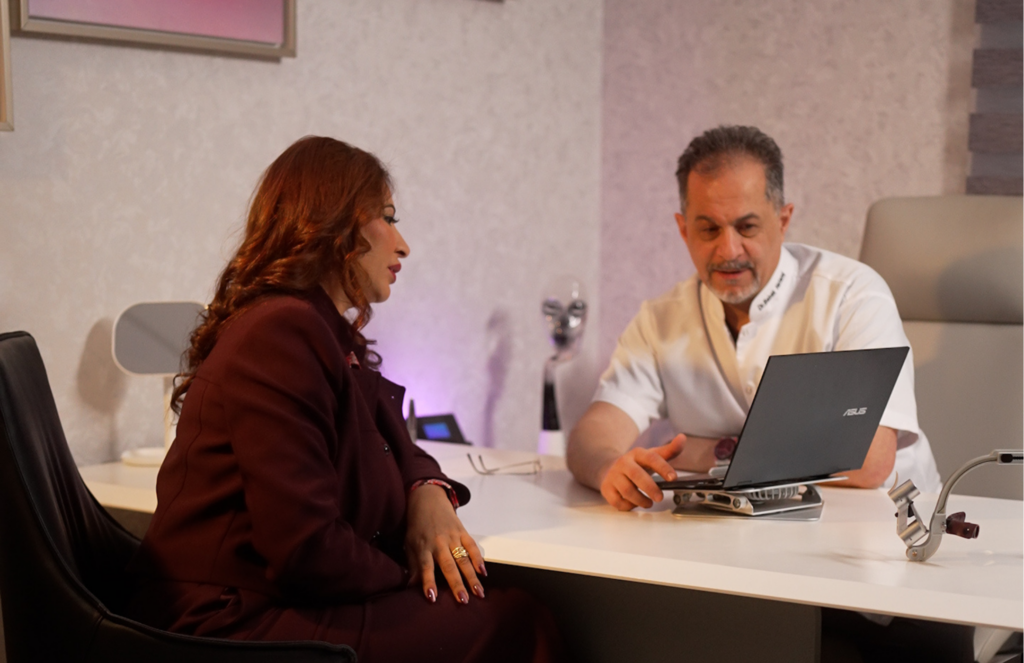
Everything begins with a thorough consultation. The surgeon listens to what bothers you, examines your face from the front and from the side, evaluates your bite and assesses the thickness and elasticity of your soft tissues. Your medical history, medications, previous surgeries and lifestyle habits are carefully reviewed.
Photographs are taken from different angles, and the profile is analysed using reference lines and proportions. In many cases, digital simulation on these photos helps you visualise how the profile could change with different degrees of projection. This step is valuable because it turns an abstract idea into something you can see, and it allows you to discuss the result before making any decision. The simulation is a communication tool, not an exact prediction, but it helps align expectations.
When surgery is scheduled, you receive clear instructions for the weeks before the procedure. These may include stopping certain medications or supplements that affect bleeding, avoiding smoking and alcohol, and completing any tests the surgeon requires.
On the day of surgery, the procedure generally follows these steps:
- anaesthesia is administered, either general anaesthesia or local anaesthesia with sedation, depending on the technique and the case
- the incision is made inside the mouth or in the crease beneath the chin
- for an implant, a precise pocket is created over the bone and the implant is positioned and secured
- for genioplasty, the bone segment is cut, advanced and fixed with small plates and screws
- the incision is closed and a supportive dressing or tape may be applied
The duration depends on the technique and on whether weak chin surgery is combined with other procedures, such as rhinoplasty or neck contouring. An implant procedure is usually relatively short, while genioplasty requires more time.
After surgery, you are monitored until you are comfortable and ready to go home or to rest at the clinic, according to the surgeon’s indications. You leave with detailed aftercare instructions, medication if needed and a schedule of follow-up visits. Understanding each phase in advance helps many patients feel calm and confident, which is an important part of a positive surgical experience.
What Is Recovery Like After Weak Chin Surgery?
Recovery after weak chin surgery is generally well tolerated, and knowing what to expect helps you plan with peace of mind. Every patient heals differently, but there are some typical stages.
In the first few days, swelling and a feeling of tightness around the chin and lower lip are normal. Some bruising may appear and gradually move down towards the neck. Discomfort is usually controlled with the medication prescribed by the surgeon. Sleeping with the head slightly elevated and using cold compresses as instructed helps reduce swelling.
If the incision was made inside the mouth, oral hygiene becomes particularly important. You may be asked to rinse with a specific mouthwash and to follow a soft diet for some days, avoiding foods that are hard, sticky or that require wide mouth opening. Talking and smiling may feel slightly stiff at first.
During the first two weeks, most of the visible swelling and bruising improves, and many people return to desk work and light social activities within about one week, depending on the technique. After genioplasty, recovery is usually a little longer than after an implant.
Some sensations are common and generally temporary:
- numbness of the lower lip and chin, caused by the stretching of small nerves
- a feeling that the chin is “too big” while swelling is still present
- mild asymmetry in the early weeks, which tends to settle as tissues heal
Physical activity is reintroduced gradually. Intense exercise, contact sports and activities that risk a blow to the face should be avoided for the period your surgeon indicates. Exposure to strong sun and heat, which is particularly relevant in Dubai, can increase swelling, so it is wise to stay in cool environments and protect any external scar from sunlight.
The final result of weak chin surgery becomes visible gradually. Most of the swelling resolves within the first weeks, but subtle swelling can persist for several months. Attending all follow-up visits allows the surgeon to monitor healing and address any concern promptly. Patience during this phase is part of the process after weak chin surgery, and it is what allows the new profile to settle naturally.
What Results Can You Expect and Why Should You Avoid Shortcuts?
When weak chin surgery is planned and performed carefully, the results can be among the most satisfying in facial aesthetics. Patients often describe the change as “subtle but powerful”: friends notice that they look more confident or more rested, without being able to say exactly what has changed.
The most common improvements include:
- a more balanced profile, with better proportion between nose, lips and chin
- a longer, more defined jawline
- a clearer separation between chin and neck
- a lower face that looks stronger and more structured
Results are long-lasting. An implant is designed to remain in place permanently, and in genioplasty your own repositioned bone heals in its new position. The face continues to age naturally, but the improved structure remains. Weak chin surgery cannot, however, correct loose skin on the neck, a significant bite problem or excess fat under the chin on its own. These concerns may need additional treatments, and a good surgeon will explain this clearly.
Online, many people look for shortcuts to change their chin without surgery. Some of these are harmless but ineffective, while others can be harmful:
- jaw exercises, tongue posture techniques and “jawline trainers” promise to reshape the chin, but they cannot move or enlarge bone in adults and may strain the jaw joint
- tapes, straps and devices worn at night have no effect on the bone structure
- filler injections performed by unqualified operators, or with products of uncertain origin, can cause lumps, infections, migration of material and, in rare cases, serious complications
- low-quality procedures performed without proper evaluation or follow-up expose patients to risks that may be difficult to correct later
The safest way to improve a weak chin is a professional assessment followed, when appropriate, by weak chin surgery performed in a safe medical environment with clear follow-up. This approach protects both your health and the quality of the result.
Seeing your new profile emerge as swelling fades is often an emotional moment. Many patients say they finally recognise themselves in side-view photographs. This is the real value of weak chin surgery: not changing who you are, but allowing your face to express its natural harmony.
What Determines the Cost of Weak Chin Surgery?
It is natural to wonder about the cost of weak chin surgery before taking a decision. The honest answer is that it depends on many factors and can vary from patient to patient, based on the individual situation. For this reason, it is not possible to give one figure that applies to everyone.
Some of the main elements that influence the overall investment are:
- the technique chosen, as a chin implant and a sliding genioplasty involve different levels of complexity, time and materials
- the type of implant, when an implant is used
- the type of anaesthesia and the facility where the procedure is performed
- any pre-operative tests or imaging required
- whether weak chin surgery is combined with other procedures, such as rhinoplasty or neck contouring
- post-operative medication, supplies and follow-up visits
When people look into chin procedures, they quickly notice that the final figure is made of several components. The Chin Augmentation Cost generally reflects the surgeon’s fee, anaesthesia, the facility and nursing team, imaging before surgery, medication and supplies after surgery and the follow-up visits during healing. It is also useful to consider indirect elements, such as time away from work, help at home during the first days and, if travelling, accommodation and the companion’s stay. Fillers may seem simpler at first, but repeating them regularly over the years can become a significant commitment compared with a single surgical correction.
Another important consideration is safety. Choosing a procedure only because it seems more convenient can lead to complications that require further treatment. A plan based on a careful evaluation, a qualified surgeon and proper follow-up is a more responsible investment in your face.
During the consultation, after examining your profile and discussing your goals, the surgeon can recommend the most suitable technique and provide a clear, personalised estimate. This way, you can make your decision with complete information about the procedure, the recovery and what weak chin surgery can realistically achieve for you.
Weak Chin Surgery: Final Thoughts on a More Balanced Profile
A weak chin can influence the entire face, making the nose look larger, the jawline softer and the profile less balanced. Weak chin surgery is a way to restore natural proportion, whether through a chin implant or a sliding genioplasty, always chosen according to your anatomy and your goals.
In this article we have seen what a weak chin is, what weak chin surgery involves, what options exist, who can be a good candidate, what happens during the consultation and the procedure, what recovery looks like and what results are realistic. We have also seen why exercises, devices and unqualified treatments cannot replace a professional evaluation, and which factors influence the overall investment.
If you would like to understand how your profile could change and which approach suits your face, you can explore the topic in a calm, detailed consultation with Dr. Babak Hatami in Dubai, where every question receives a clear answer and every plan is built around you.